.png)
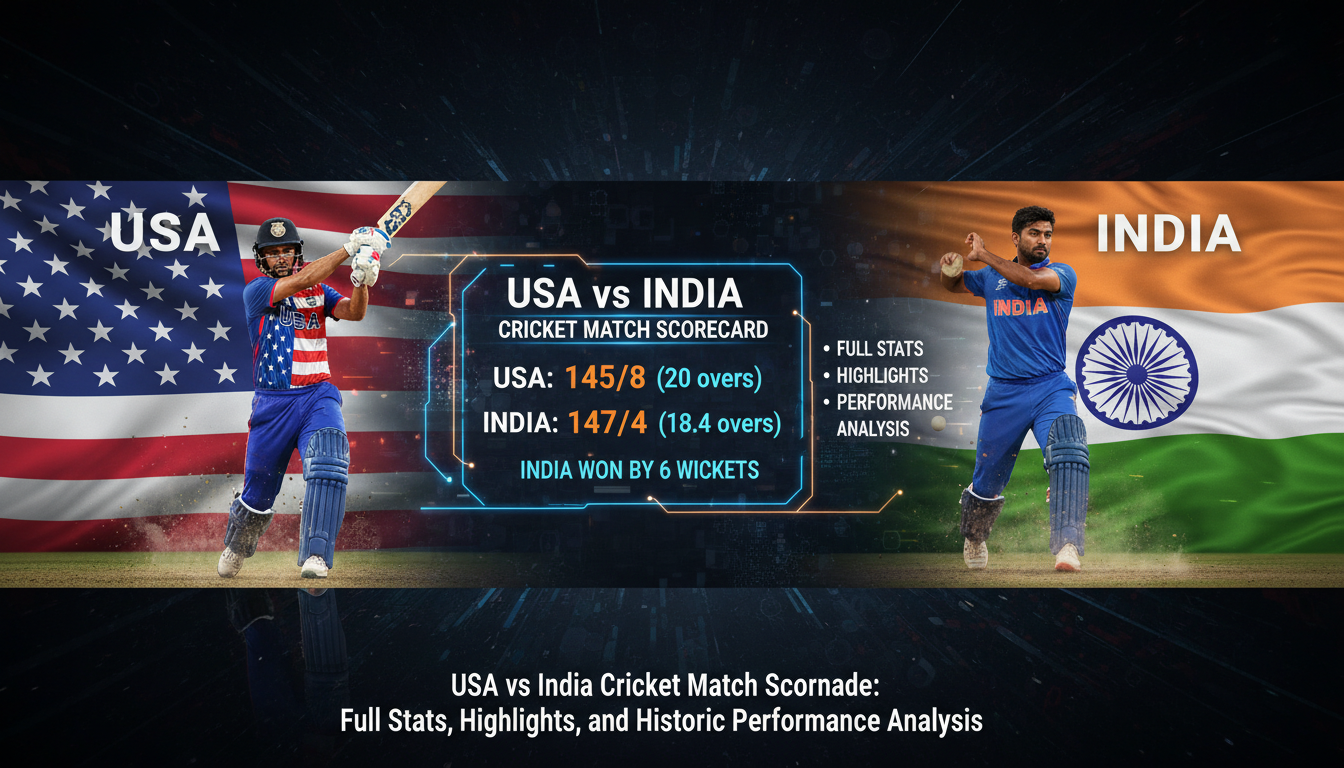
Introduction: A Historic Clash in Nassau County
The encounter between the United States and India at the ICC Men’s T20 World Cup 2024 was more than just a group stage match; it was a landmark event in the global expansion of cricket. While India entered the contest as heavy favorites with a legacy of dominance, the USA team, playing on home soil at the Nassau County International Cricket Stadium in New York, brought a spirit of resilience that captured the world’s attention. This article provides a comprehensive USA vs India cricket match scorecard analysis, breaking down every run, wicket, and strategic maneuver that defined this low-scoring thriller.
For cricket enthusiasts and analysts alike, dissecting the metrics of this game reveals how a tricky pitch, disciplined bowling, and high-pressure fielding can equalize the contest between a cricketing superpower and an emerging associate nation. Beyond the raw numbers, we explore the narrative of Saurabh Netravalkar’s swing, Arshdeep Singh’s precision, and Suryakumar Yadav’s composure.
Whether you were following digital news alerts for real-time updates or watching from the stands, the intensity was palpable. This deep dive covers the full stats, player performance metrics, and the historic implications of the match.
Match Overview: The Stage and The Stakes
Venue and Conditions
The match took place at the pop-up stadium in Nassau County, New York. The pitch had been a talking point throughout the tournament due to its unpredictable bounce and sluggish nature, often favoring bowlers significantly. Understanding the local weather forecast tomorrow and the current atmospheric conditions was crucial for the captains at the toss, as overcast skies promised swing for the seamers.
The Toss
India won the toss and elected to field first. This decision was strategic, aiming to utilize the fresh moisture in the surface—a move that paid dividends almost immediately.
USA Innings Analysis: The Battle for Survival
The USA batting lineup faced a stern test against India’s world-class pace attack. The scorecard reflects a struggle for momentum, punctuated by brief moments of resistance.
Top Order Collapse
The innings began disastrously for the hosts. Arshdeep Singh, swinging the ball prodigiously, trapped Shayan Jahangir lbw on the very first ball of the match. The pressure mounted as Andries Gous fell shortly after, leaving the USA reeling. The top-order collapse highlighted the gap in experience when facing elite bowling on a demanding surface.
Middle Order Resistance
Despite the early setbacks, the USA found stability through Nitish Kumar and Steven Taylor. Nitish Kumar, in particular, played a gritty knock, top-scoring for his side. His ability to rotate the strike and find the occasional boundary was crucial in dragging the team total towards respectability. The partnership was not just about runs; it was about proving that USA batters could hang with the best.
- Steven Taylor: 24 runs off 30 balls
- Nitish Kumar: 27 runs off 23 balls
- Corey Anderson: 15 runs off 12 balls
India’s Bowling Figures
India’s bowling card was a testament to discipline. Arshdeep Singh was the standout performer, utilizing the conditions to perfection.
- Arshdeep Singh: 4 overs, 9 runs, 4 wickets (Player of the Match)
- Hardik Pandya: 4 overs, 14 runs, 2 wickets
- Axar Patel: 3 overs, 25 runs, 1 wicket
The USA finished their innings at 110/8 in 20 overs. While not a massive total, on this pitch, it was enough to make India nervous.
India Innings Analysis: A Test of Composure
Chasing 111 should have been a walk in the park for India, but the USA vs India cricket match scorecard tells a different story of early jitters and a tense finish.
The Netravalkar Effect
Saurabh Netravalkar, a software engineer turned cricketing hero for the USA, delivered a dream spell. He dismissed Virat Kohli for a golden duck—a rarity that sent shockwaves through the stadium. Shortly after, he claimed the wicket of Rohit Sharma, India’s captain. Suddenly, India was 10/2, and the upset seemed possible. This moment was arguably the peak of viral entertainment news for the tournament, as social media exploded with clips of the underdog dismantling the giants.
Stabilizing the Ship: Suryakumar Yadav and Shivam Dube
With the openers gone and Rishabh Pant dismissed after a brief stay, the onus fell on Suryakumar Yadav (SKY) and Shivam Dube. Unlike his usual explosive self, SKY played a mature, calculated innings. He curbed his natural instincts to sweep and loft, instead focusing on playing straight and respecting the good balls.
Shivam Dube, initially struggling to time the ball, found his rhythm late in the innings. Their unbroken partnership of 72 runs guided India home.
- Suryakumar Yadav: 50* off 49 balls
- Shivam Dube: 31* off 35 balls
- Rishabh Pant: 18 off 20 balls
India finished at 111/3 in 18.2 overs, winning by 7 wickets.
Key Turning Points and Highlights
1. The 5-Run Penalty
A rare and decisive moment occurred late in the second innings. The USA was penalized 5 runs because they failed to begin a new over within 60 seconds on three separate occasions (the new stop-clock rule). This penalty reduced the required runs for India and eased the pressure significantly at a crunch moment. Analysts often compare such precise rule enforcement to high-growth stock market analysis—where small, technical details can drastically shift the outcome.
2. Arshdeep’s Opening Spell
Taking a wicket on the first ball set the tone. It forced the USA into a defensive shell from which they never fully recovered. His figures of 4/9 are among the best for India in T20 World Cups.
3. The Dropped Catch
Saurabh Netravalkar induced a false shot from Suryakumar Yadav when he was on a low score, but the catch was dropped by the USA fielder. Had that stuck, the USA vs India cricket match scorecard might have looked very different, potentially leading to one of the biggest upsets in history.
Statistical Deep Dive: Advanced Metrics
Just as analysts perform a Phoenix Suns vs LA Lakers definitive player stats breakdown for the NBA, cricket demands a look at advanced metrics to understand player impact.
Dot Ball Percentage
India’s bowlers bowled over 50% dot balls in the first innings. This suffocation prevented the USA from building any momentum. In T20 cricket, dot balls are gold dust, creating pressure that leads to wickets.
Phase Analysis
- Powerplay (1-6 overs): USA 18/2 vs India 15/2. Both teams struggled, showing the difficulty of the new ball on this pitch.
- Middle Overs (7-15): USA 56/3 vs India 61/1. India won this phase largely due to the SKY-Dube partnership.
- Death Overs (16-20): USA managed 36 runs, but losing wickets halted their charge.
Comparative Analysis: USA’s Rise vs India’s Dominance
This match was a microcosm of the changing landscape of cricket. India, a powerhouse with robust infrastructure, faced a USA team composed of diverse talent, many of whom balance cricket with full-time jobs. For fans watching via best StreamEast live alternatives, the narrative was compelling: the underdog putting up a fight against the titan.
The USA’s performance proved they belong on the big stage. Qualifying for the Super 8s (which they eventually did) was a massive achievement, boosting their ICC rankings and

The editor of All-AI.Tools is a professional technology writer specializing in artificial intelligence and chatbot tools. With a strong focus on delivering clear, accurate, and up-to-date content, they provide readers with in-depth guides, expert insights, and practical information on the latest AI innovations. Committed to fostering understanding of fun AI tools and their real-world applications, the editor ensures that All-AI.Tools remains a reliable and authoritative resource for professionals, developers, and AI enthusiasts.