.png)
Introduction: The Apex of Upper Body Strength
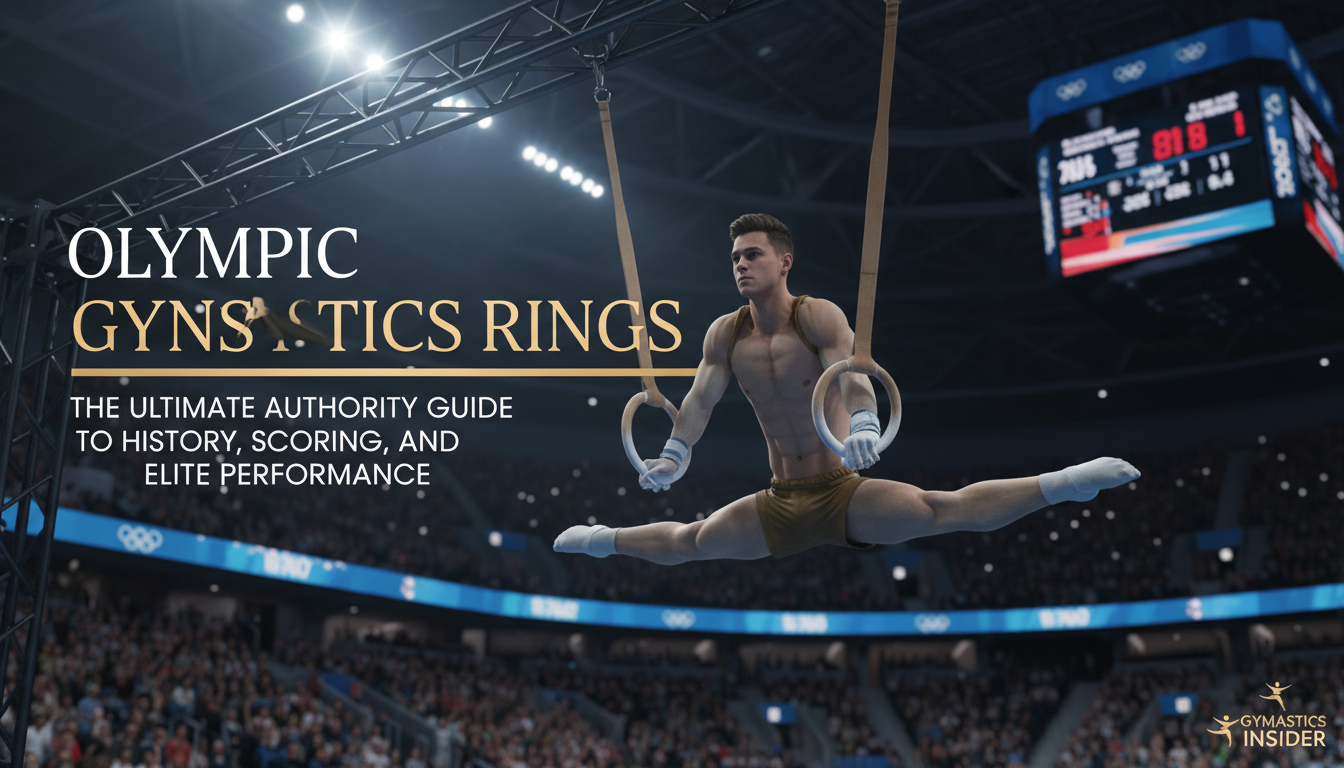
Among all apparatuses in Men’s Artistic Gymnastics (MAG), the Olympic Gymnastics Rings stand apart as the ultimate test of pure upper body strength, stability, and biomechanical precision. Often referred to as the "Still Rings," this event requires athletes to perform a routine combining swing, strength, and hold elements while suspending themselves on two unstable rings 2.8 meters above the floor. Unlike the floor exercise or vault, where the ground provides stability, the rings move freely, demanding that the gymnast act as the stabilizing force.
For decades, the rings have been the domain of specialists—athletes with incredible power-to-weight ratios who can defy gravity with static holds like the Iron Cross and the Maltese. However, understanding the rings requires more than just admiring the muscles involved; it requires a deep dive into the physics, history, and scoring complexities that define the sport at the elite level.
In this comprehensive guide, we explore the evolution of the apparatus, the intricacies of the FIG (International Gymnastics Federation) Code of Points, and the physiological demands placed on Olympic champions. Whether you are a gymnastics enthusiast, a CrossFit practitioner looking to improve your muscle-up, or a sports analyst interested in advanced metrics and performance analysis, this article serves as the definitive authority on the subject.
For those interested in how technology intersects with sports training and analytics, visit All AI Tools for broader insights into the digital evolution of performance tracking.
The Evolution of the Rings: A Historical Deep Dive
From Roman Origins to the Modern Olympics
The concept of ring training dates back roughly 2,000 years, originally developed by the Romans for physical conditioning. However, the modern iteration of the "flying rings" (swinging) and "still rings" (static) emerged in 19th-century Germany under the tutelage of Friedrich Ludwig Jahn, the "father of gymnastics." Initially, the rings were triangular, but they evolved into the circular shape we recognize today to allow for better grip and fluid rotation.
The rings debuted at the first modern Olympic Games in Athens in 1896. In the early 20th century, competitions often included both swinging and stationary routines. It wasn’t until the mid-20th century that the FIG standardized the event to "Still Rings," emphasizing control and eliminating the dangerous swinging arcs that characterized early performances.
Equipment Standardization
Modern Olympic rings are marvels of engineering designed to ensure fairness and safety:
- Material: The rings are made of wood (typically laminated) to provide grip and absorb sweat. Plastic or metal rings are rarely used in elite competition due to slippage risks.
- Dimensions: The inner diameter is 18 cm, and the profile thickness is 28 mm.
- Suspension: They hang from a cable and strap system attached to a metal frame 5.8 meters high. The distance between the rings is exactly 50 cm.
- Elasticity: A spring-loaded swivel mechanism at the top of the frame reduces the shock on the athlete’s shoulders during dynamic landings.
Understanding the Physics: Biomechanics of Suspension
To master the rings, a gymnast must manipulate torque and leverage. The human body acts as a third-class lever during moves like the Iron Cross. The shoulders are the fulcrum, the arms are the lever arm, and the body weight is the load. The longer the lever (the arms), the greater the force required to hold the position.
The instability of the straps adds a component of proprioception—the body’s ability to sense its position in space. The gymnast must constantly micro-adjust stabilizer muscles to keep the rings from swinging. A deduction is applied if the cables swing or cross, making absolute stillness the gold standard. This level of physical stress is immense; research into what scientific research reveals about longevity suggests that elite athletes often undergo significant adaptation in connective tissues to withstand these forces over time.
Decoding the Code of Points: How Scoring Works
The International Gymnastics Federation (FIG) updates the Code of Points every Olympic cycle (four years) to encourage evolution in the sport. The final score is a sum of the Difficulty (D) Score and the Execution (E) Score.
The Difficulty (D) Score
The D-score is open-ended. It is calculated by summing the values of the top 8 elements (including the dismount) and adding Connection Value (CV) and Element Group Requirements (EGR). Elements are rated from A (easiest, 0.10) to I (extremely difficult, 0.90) and beyond.
Element Groups on Rings:
- Kip and Swing Elements: Movements that transition from a hang to support (e.g., muscle-ups, kips).
- Strength Elements and Hold Elements: The core of ring scoring (e.g., Iron Cross, Maltese, Planche). A hold must be maintained for a minimum of 2 seconds.
- Swing to Strength Hold Elements: Swinging up directly into a static hold (e.g., Azarian).
- Dismounts: The landing.
The Execution (E) Score
The E-score starts at 10.0, and judges deduct points for errors. On rings, specific deductions include:
- Bent Arms: In strength holds, arms must be perfectly straight. Even a slight bend incurs a deduction.
- Hold Time: Holding a strength move for less than 2 seconds results in a severe deduction or non-recognition of the element.
- Cable Swing: Any shaking or swinging of the cables during a static hold is penalized.
- Landing: A step or hop on the dismount results in deductions ranging from 0.1 to 0.3 or more for a fall.
The subjectivity of judging has often sparked debates about implementing technology for fairer results. As we look at future trends in technology, AI-driven motion capture is becoming a viable tool for analyzing joint angles and hold times with mathematical precision, potentially revolutionizing how scores are awarded.
The Physiology of Elite Ring Specialists
Strength-to-Weight Ratio
Ring specialists are typically shorter and lighter than other athletes. A shorter skeletal structure provides a mechanical advantage (shorter levers). The ideal physique involves massive upper body hypertrophy (shoulders, lats, biceps) coupled with a light lower body.
Injury Risks and Prevention
The strain on the biceps tendon, rotator cuff, and pectoral insertions is enormous. "Ring bicep" is a common ailment where the tendon becomes inflamed due to the intense torque of the Maltese and Planche. Elite programs now utilize advanced physiotherapy and data monitoring to manage load. However, the challenges in implementing advanced health monitoring in daily training remain high due to the cost and complexity of biometric gear suitable for high-impact sports.
Furthermore, the mental fortitude required to perform dangerous skills like the triple-back dismount cannot be overstated. Athletes utilize various psychological tools to manage fear and focus. For those interested in how technology aids in this area, exploring tools to better support mental health and well-being can provide insight into the cognitive side of elite performance.
Iconic Moves and Legends of the Sport
Signature Elements
- The Iron Cross: The gymnast hangs with arms extended laterally at shoulder height.
- The Maltese: The body is horizontal, parallel to the ground, supported by arms at a wide angle.
- The Victorian: An inverted Maltese where the body is held horizontal with the chest facing the ceiling—one of the hardest elements in the code.
- The Nakayama: A back lever pull to an Iron Cross.
Legends of the Rings
Albert Azaryan (USSR): The "King of Rings," famous for performing the Iron Cross while turning his head to smile at the judges, signaling ease.
Chen Yibing (China): Known as the "Lord of the Rings" in the modern era, his execution was nearly flawless, defining the dominance of the Chinese team in the 2008 and 2012 eras.
Eleftherios Petrounias (Greece): A modern master who dominated the 2016 Rio Olympics, known for his incredible stability and body line.
Yuri van Gelder (Netherlands): Famous for his extreme strength and bringing mainstream attention to the event, though his career had fluctuations.
Technology’s Role in Modern Gymnastics
While the rings are an ancient apparatus, the training methodology is cutting-edge. High-frame-rate cameras and force plates are used to analyze the efficiency of the swing. Biomechanical analysis helps coaches adjust the athlete’s technique by millimeters to reduce joint strain and maximize hold duration.
In the digital age, fans and analysts also use technology to track performance trends. Just as one might look for alternatives for streaming live sports, gymnastics enthusiasts are turning to digital platforms to watch frame-by-frame breakdowns of complex routines, democratizing technical knowledge that was once hidden behind gym doors.
Frequently Asked Questions
1. Why do gymnasts wear grips on the rings?
Gymnasts wear leather grips (dowels) to maintain a secure hold on the wooden rings and to protect their hands from friction blisters. The dowel creates a "hook" effect over the ring, allowing the gymnast to hang with less forearm fatigue during swinging elements.
2. How are the rings stabilized?
The rings themselves are not stabilized; they are free-swinging. The stability comes entirely from the gymnast’s muscles. If you see the cables shaking, it is because the gymnast is struggling to control the energy. Judges deduct points for swinging cables during strength holds.
3. What is the height limit for ring gymnasts?
There is no official height limit, but physics favors shorter athletes. Most elite ring specialists are between 5’1" (155 cm) and 5’6" (167 cm). Taller gymnasts have longer levers (arms and legs), which exponentially increases the force required to perform moves like the Maltese or Planche.
4. How is the "stop" time measured?
A strength element must be held for a minimum of 2 seconds. In modern competitions, judges often use a silent mental count or review video replay (Instant Replay Analysis) to ensure the hold was sufficient. If the hold is 1.9 seconds, the element may be downgraded or not counted.
5. Why do coaches lift gymnasts onto the rings?
Starting the routine requires the gymnast to grasp the rings at a height of 2.8 meters. Coaches lift them to conserve the athlete’s energy for the routine. The routine officially begins the moment the gymnast’s feet leave the floor or the coach releases them.
Conclusion
The Olympic Gymnastics Rings remain the purest exhibition of human upper-body strength in the sporting world. From the historical evolution of the apparatus to the intricate Code of Points that governs modern scoring, the rings demand a unique blend of power, precision, and artistry. While the physics of levers and torque dictate the difficulty, it is the dedication of the athletes that brings these gravity-defying moments to life.
As the sport continues to evolve with better training methodologies and potentially AI-assisted judging, the standard of performance will likely push the boundaries of human physiology even further. For enthusiasts tracking the intersection of sports, data, and technology, staying updated with resources like All AI Tools ensures you remain at the forefront of these developments.

The editor of All-AI.Tools is a professional technology writer specializing in artificial intelligence and chatbot tools. With a strong focus on delivering clear, accurate, and up-to-date content, they provide readers with in-depth guides, expert insights, and practical information on the latest AI innovations. Committed to fostering understanding of fun AI tools and their real-world applications, the editor ensures that All-AI.Tools remains a reliable and authoritative resource for professionals, developers, and AI enthusiasts.