.png)
Introduction
In the rapidly evolving landscape of digital puzzles, few daily rituals have captured the collective intellect of the internet quite like the New York Times Connections. For many, the morning coffee is incomplete without staring at a grid of 16 words, attempting to decipher the hidden logic that binds them into four distinct categories. As a senior tech analyst and avid puzzle strategist, I have analyzed the algorithmic patterns and semantic structures that Wyna Liu and the NYT Games team employ to challenge our lateral thinking skills.
If you are looking for NYT Connections hints today, you are likely facing a particularly deceptive grid. The game is designed to mislead, utilizing semantic overlap—what we in the AI industry refer to as "high-dimensional vector proximity"—where words appear to belong to multiple categories simultaneously. Whether you are stuck on a tricky Purple category or trying to preserve your perfect streak, understanding the underlying architecture of the puzzle is key.
In this comprehensive guide, we will break down expert strategies for solving Connections, analyze the common category tropes, and explore how technology intersects with modern word games. For specific daily solutions and breakdowns, you can always check our dedicated resource on connection hint mashable nyt answer todays puzzle solved to get unstuck immediately.
The Anatomy of the Puzzle: Decoding Color Difficulty
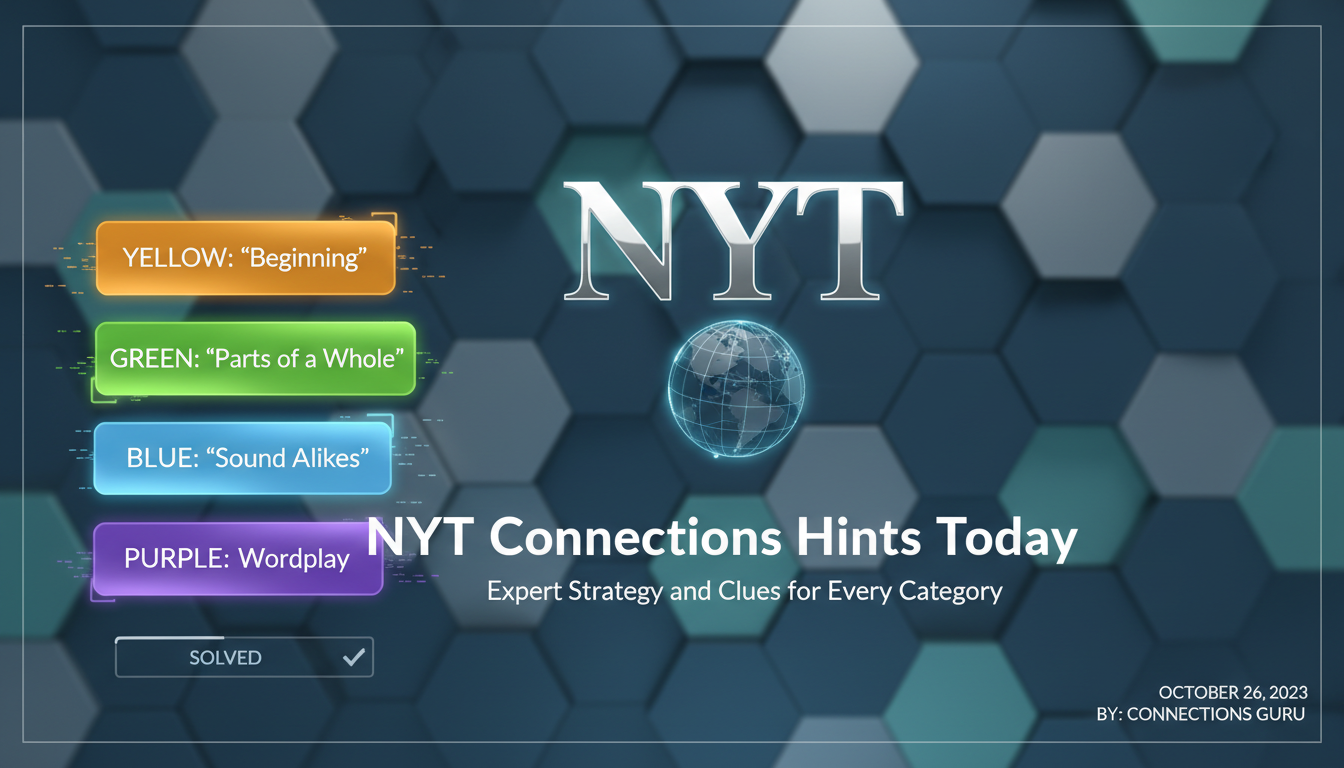
To master NYT Connections, one must first respect the hierarchy of difficulty. The game is not merely a word search; it is a test of pattern recognition. The four color-coded groups represent ascending levels of abstraction. Understanding this gradient is crucial for eliminating the "easy" words first to declutter your board.
Yellow: The Straightforward Semantic Cluster
The Yellow group is theoretically the easiest. These categories usually rely on direct synonymy or strong thematic association. For example, a category might be "Types of Footwear" or "Synonyms for Happy." However, do not be lulled into a false sense of security. The puzzle creators often place "trap words" here—words that could fit a Yellow category but actually belong to a more complex Purple or Blue group.
Green: The Contextual Challenge
Green categories require a slight shift in perspective. These are often related to "Parts of a Whole" or slightly more specific functional groups. While Yellow might be "Fruit," Green might be "Fruits with Inedible Skins." This increase in specificity is where many players lose their first life. It demands that you look past the immediate definition of the word and consider its attributes.
Blue: The Trivia and Knowledge Sector
Blue is where the game shifts from vocabulary to general knowledge. These categories often involve specific domains such as geography, pop culture, science, or brand names. You might encounter categories like "NBA Team Mascots," "Elements on the Periodic Table," or "Words Following ‘Blue’." This is often where digital tools come in handy. If you are unfamiliar with a specific niche, utilizing search strategies or AI assistants can be pivotal. We often discuss how to ask AI a question effectively to retrieve specific trivia without spoiling the entire puzzle.
Purple: The Abstract and Linguistic Trickster
Purple is the "final boss" of Connections. These categories rarely rely on the meaning of the words. Instead, they focus on wordplay, phonetics, spelling patterns, or compound word associations. Examples include "Words that are Palindromes," "Words that sound like Letters," or "Words ending in ‘X’." Solving the Purple category often requires you to stop reading the word for its definition and start analyzing it as a string of characters.
Mastering the Gameplay: Advanced Strategies
As an expert in AI and digital logic, I approach Connections the same way an algorithm processes data: by identifying outliers and clusters. Here are the strategies I use to maintain a 100% solve rate.
1. The "Shuffle" is Essential
Our brains are wired to find patterns in proximity. If two words are sitting next to each other in the grid, you will subconsciously force a connection. Use the Shuffle button repeatedly to break these visual biases. Seeing the words in a new configuration often triggers a fresh perspective, allowing you to spot a connection you missed.
2. Identify the Red Herrings
The core difficulty of Connections lies in the "fifth word." The puzzle often contains five words that fit into a category that only requires four. This is a deliberate trap. If you spot five words that could mean "Sharp Objects," do not guess. Stop and look for a second category. One of those five words belongs somewhere else. Once you identify the alternative home for the fifth word, the original category becomes clear.
3. Solve Purple by Default
Often, the Purple category is too abstract to spot directly. A valid strategy is to solve the Yellow, Green, and Blue categories first. If you can successfully group the first 12 words, the remaining four will automatically form the Purple category, saving you the mental gymnastics of figuring out that they all "Rhyme with a type of Cheese."
The Intersection of AI and Word Puzzles
In the tech world, we often compare human cognition to Large Language Models (LLMs). Interestingly, games like Connections are notoriously difficult for AI to solve consistently. While an AI can define words instantly, the lateral thinking required to associate "Bark" (Tree), "Bark" (Dog), and "Bark" (Boat) into specific distinct categories based on context is a high-level reasoning task.
However, newer models are closing the gap. We have seen significant advancements in reasoning capabilities. For instance, when comparing models, one might ask, is DeepSeek better than ChatGPT for solving logic puzzles? The answer often lies in the model’s training data regarding nuances and idioms. While AI can be a helpful hint generator, the joy of Connections remains in the human "Aha!" moment.
Managing Digital Distractions and Gaming Habits
For many, NYT Connections is a quick break during the work or school day. It acts as a mental palate cleanser. But what happens when you finish the puzzle in two minutes and still need a break? The search for browser-based entertainment is common in professional and academic environments.
If you’ve wrapped up your NYT Connections hints today and need another diversion, many users turn to unblocked gaming sites. We have explored various options for this, including unblocked game websites for school that bypass restriction filters safely. Whether it’s a quick round of strategy or a physics-based puzzler, maintaining mental agility is key.
One popular alternative that challenges predictive reasoning is the "What Beats Rock" phenomenon. You can learn more about this in our guide on the What Beats Rock game unblocked. Just like Connections, it requires thinking outside the box—or in this case, outside the traditional Rock-Paper-Scissors loop.
Daily Clues and Category Breakdowns
While I cannot predict the specific words for the exact moment you are reading this (as the puzzle changes daily at midnight), I can provide a framework for the types of clues you should look for today. When scanning your grid, ask yourself these diagnostic questions:
- Are there proper nouns? If you see capitalized words, think Blue category. Are they cities? Names of artists? Characters from a TV show?
- Are there verbs acting as nouns? Words like "Trip," "Fall," or "Spring" are classic homophones used to confuse categories.
- Is there a "Fill in the Blank" pattern? Look for words that feel incomplete. If you see "Grand," "Baby," and "Up," try adding a word before or after them (e.g., "Grand Piano," "Baby Grand," "Upright Piano").
For a broader look at digital tools and trends that influence how we play and work, visit All AI Tools. Staying updated on the latest tech trends can surprisingly sharpen the analytical skills needed for these daily puzzles.
Frequently Asked Questions
1. When does NYT Connections reset?
The New York Times Connections puzzle resets daily at midnight, local time. However, it often syncs with the Eastern Time Zone (ET) for the global release on the app. This means if you are on the West Coast, you might get access as early as 9:00 PM the previous night.
2. Does the order of words in the grid matter?
No. The initial arrangement of the 16 words is completely random. The proximity of words is often generated to deliberately confuse you (red herrings). Always use the shuffle button to visualize new patterns.
3. Is there a way to play previous Connections puzzles?
Officially, the NYT Games app focuses on the daily puzzle and does not offer a robust archive mode like the Crossword. However, various third-party archive sites have popped up that allow you to play past puzzles. Always be cautious of ad-heavy sites when looking for archives.
4. Why are some categories so specific?
The editor, Wyna Liu, aims to balance the puzzle for a wide audience. Specific categories (often Blue or Purple) reward players with niche knowledge or strong wordplay skills. This variance ensures that the game remains challenging even for those with large vocabularies.
5. Can I use AI to solve the puzzle?
Yes, you can paste the 16 words into an AI chatbot and ask it to categorize them. However, AI often struggles with the "Purple" wordplay categories. It is excellent for synonym mapping but less effective at phonetic tricks. It serves better as a hint generator than a solver.
Conclusion
Solving NYT Connections is a daily exercise in cognitive flexibility. It challenges us to look beyond the surface definition of words and explore the rich, interconnected web of language. Whether you are a casual player or a competitive streak-keeper, understanding the mechanics of the four color-coded categories is the best way to improve your game.
Remember, when you are stuck on NYT Connections hints today, take a step back. Shuffle the board. Look for the outliers. And if you truly hit a wall, there is no shame in seeking a nudge from expert guides or digital tools. The goal is to keep your brain active and engaged. Happy solving!

The editor of All-AI.Tools is a professional technology writer specializing in artificial intelligence and chatbot tools. With a strong focus on delivering clear, accurate, and up-to-date content, they provide readers with in-depth guides, expert insights, and practical information on the latest AI innovations. Committed to fostering understanding of fun AI tools and their real-world applications, the editor ensures that All-AI.Tools remains a reliable and authoritative resource for professionals, developers, and AI enthusiasts.