.png)
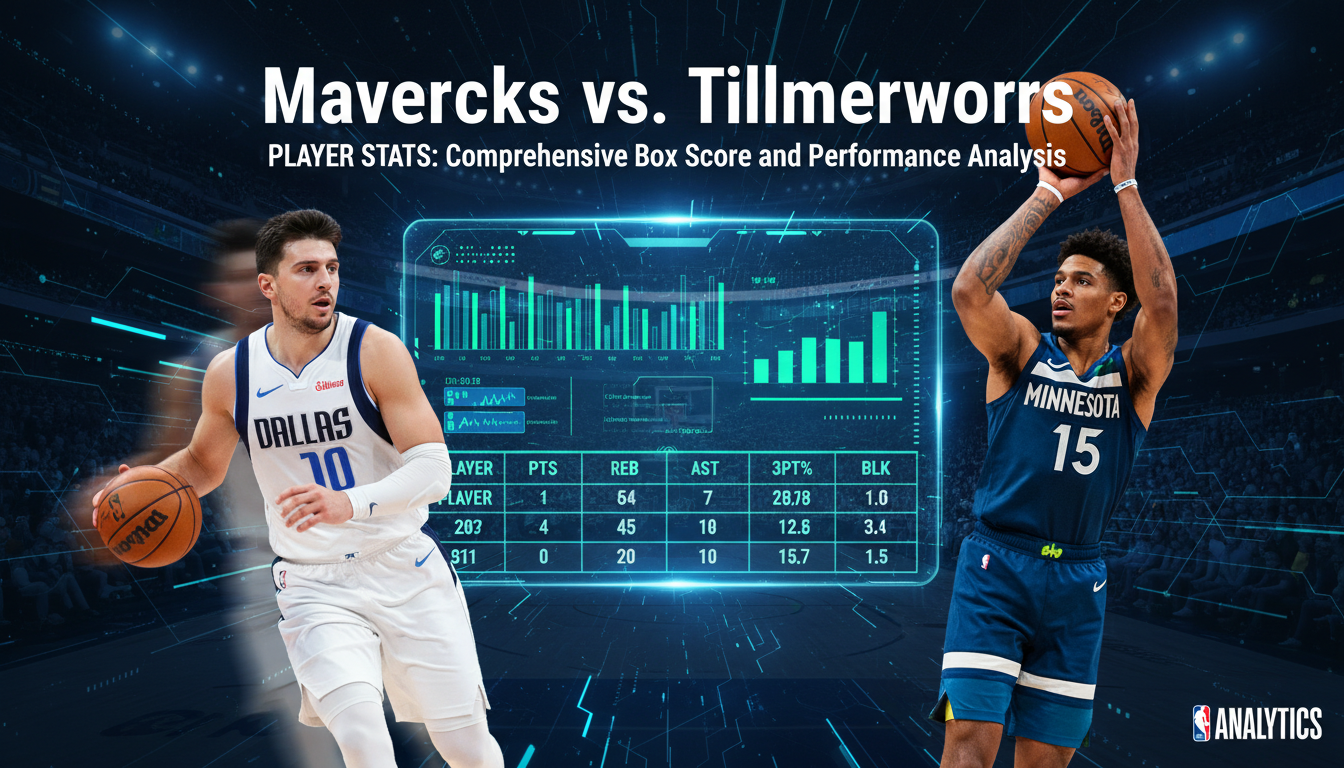
Introduction: The Battle for Western Conference Supremacy
In the evolving landscape of the NBA Western Conference, few matchups ignite as much analytical interest as the Dallas Mavericks versus the Minnesota Timberwolves. As two powerhouses with contrasting styles, their encounters provide a treasure trove of data for basketball enthusiasts and analysts alike. This article delivers a deep dive into the Mavericks vs. Timberwolves player stats, breaking down the comprehensive box score numbers, advanced metrics, and the individual performance indicators that define this rivalry.
The narrative of this matchup has shifted dramatically with recent roster changes, most notably the Timberwolves’ bold moves to reshape their core around Anthony Edwards and Rudy Gobert, integrating Julius Randle, while the Mavericks continue to refine the lethal backcourt pairing of Luka Dončić and Kyrie Irving. Understanding the statistical nuances of these games goes beyond checking the final score; it requires examining effective field goal percentages, usage rates, and defensive ratings.
Whether you are a fantasy basketball manager, a sports bettor, or a die-hard fan, analyzing the Mavericks vs. Timberwolves player stats offers crucial insights into how these teams match up in the paint, on the perimeter, and in clutch situations. For those interested in how detailed sports analytics compare across different leagues, you might find similarities in the depth of analysis used in our Phoenix Suns vs. LA Lakers definitive player stats breakdown.
Head-to-Head Star Comparison: Dončić vs. Edwards
At the heart of every Mavericks vs. Timberwolves game is the duel between two of the league’s premier talents: Luka Dončić and Anthony Edwards. Their individual box scores often dictate the flow and outcome of the game.
Luka Dončić: The Orchestrator’s Efficiency
Luka Dončić remains the statistical engine of the Dallas Mavericks. In matchups against Minnesota, Dončić’s usage rate consistently hovers above 35%, a testament to his role as the primary decision-maker. His ability to manipulate Minnesota’s perimeter defense—often led by Jaden McDaniels or Anthony Edwards—reflects in his assist-to-turnover ratio.
Key statistical trends for Dončić against the Timberwolves include:
- Scoring Volume: consistently averaging near a 30-point triple-double threat.
- Paint Penetration: Dončić’s field goal percentage in the restricted area challenges Rudy Gobert’s rim protection.
- Playmaking: High assist numbers, specifically generating corner threes for teammates like P.J. Washington and Klay Thompson.
Anthony Edwards: Explosiveness and Two-Way Impact
On the other side, Anthony Edwards has evolved into a formidable two-way superstar. His player stats against Dallas highlight his aggressive scoring mentality. Edwards often leads the Timberwolves in field goal attempts (FGA), but it is his efficiency and defensive box plus/minus (DBPM) that truly stand out.
Against the Mavericks’ backcourt, Edwards utilizes his athleticism to disrupt passing lanes, often recording multiple steals per game. His True Shooting Percentage (TS%) is a critical metric to watch, as Dallas often throws double teams to force the ball out of his hands. The dynamic here is reminiscent of high-stakes metrics analyzed in other sports matchups, such as the Arizona Cardinals vs. Carolina Panthers player stats deep dive, where individual brilliance dictates team success.
Comprehensive Box Score Analysis: The Core Metrics
To truly understand the Mavericks vs. Timberwolves player stats, we must look beyond the stars to the aggregate team performance metrics that appear in the box score.
Shooting Efficiency and Spacing
The modern NBA is defined by spacing. The Mavericks rely heavily on the 3-point shot, with Dončić creating looks for shooters. In contrast, the Timberwolves, with their size, often look to dominate the mid-range and paint, though their volume of 3-point attempts has increased.
- Effective Field Goal Percentage (eFG%): This stat adjusts for the fact that a 3-point field goal is worth one more point than a 2-point field goal. In their matchups, the team with the higher eFG% almost invariably secures the win.
- Free Throw Rate (FTr): The Timberwolves, utilizing the physicality of Randle and Edwards, often aim for a high FTr. The Mavericks counter this with Luka’s uncanny ability to draw fouls.
The Battle of the Bigs: Rebounding and Rim Protection
The paint battle features a clash of philosophies. Minnesota’s Rudy Gobert is a perennial Defensive Player of the Year candidate, and his rebounding numbers (TRB) are a staple of the box score. His presence forces the Mavericks to rely on their center rotation of Dereck Lively II and Daniel Gafford to keep pace on the glass.
Key Stat to Watch: Offensive Rebound Percentage (ORB%).
If the Timberwolves can generate second-chance points via Gobert and Randle, the Mavericks’ defensive efficiency plummets. Conversely, if Lively and Gafford can neutralize Minnesota’s size, Dallas’s transition offense thrives.
Advanced Metrics: Beyond the Box Score
Standard box scores tell us what happened; advanced metrics tell us how and why. In analyzing the Mavericks vs. Timberwolves player stats, several advanced indicators provide deeper context.
Player Efficiency Rating (PER) and Usage Rate (USG%)
PER sums up a player’s positive accomplishments, subtracts the negative accomplishments, and returns a per-minute rating of a player’s performance. Luka Dončić frequently leads all players in PER in these matchups. However, the efficiency of Minnesota’s supporting cast—Naz Reid and Mike Conley—often shows up in high PER figures relative to their minutes played.
Defensive Rating (DRtg) and Impact
Rudy Gobert’s impact is best measured by the team’s Defensive Rating when he is on the floor versus when he is off. The “Gobert Effect” usually results in a significantly lower DRtg for Minnesota. For Dallas, the defensive versatility of P.J. Washington has become crucial in switching onto Minnesota’s wings. Analyzing defensive metrics is critical for understanding game outcomes, a concept further explored in our analysis of defensive performance metrics in professional sports.
Supporting Cast and Bench Production
In high-level games, depth often decides the winner. The Mavericks vs. Timberwolves player stats for the bench units reveal significant trends.
Minnesota’s Sixth Man: Naz Reid
Naz Reid has become a cult hero and a statistical anomaly for Minnesota. His ability to stretch the floor (high 3P%) while maintaining a presence in the paint makes him a nightmare for the Mavericks’ second unit. His “Per 36 Minutes” stats often rival those of starters, highlighting his efficiency.
Dallas’s Rotational Pieces
For Dallas, the contribution of players like Naji Marshall and Spencer Dinwiddie (or whoever is helming the bench guard duties) is vital. Their assist-to-turnover ratios and perimeter defense stats are key indicators of whether Dallas can maintain a lead when Dončić sits. Similar to how longevity and sustained performance are studied in science, as seen in our article on intelligence and lifespan research, the endurance and consistency of role players over a full 48 minutes are critical for NBA success.
Recent Trends and Historical Context
Looking at the last 5-10 matchups provides a clear picture of the trajectory of this rivalry. The Timberwolves have generally tried to use their size to bully Dallas, while the Mavericks use speed and spacing to negate that advantage.
Turnover Battle: Historically, Minnesota struggles with turnovers when pressured by Dallas’s active hands. Tracking the “Points Off Turnovers” stat is essential for predicting the flow of the game.
Clutch Time Performance: In games decided by 5 points or less in the last 5 minutes, Kyrie Irving’s True Shooting percentage skyrockets. This “clutch gene” is a quantifiable metric that often tilts the box score in Dallas’s favor in tight contests.
Strategic Adjustments for Future Matchups
Coaches Jason Kidd and Chris Finch are constantly adjusting their game plans based on these player stats. For Minnesota, the key is limiting Luka’s assist numbers—turning him into a pure scorer rather than a playmaker. For Dallas, the strategy revolves around pulling Gobert away from the rim to open driving lanes.
As we continue to monitor the Mavericks vs. Timberwolves player stats throughout the season, expect fluctuations based on health, trades, and tactical shifts. For more insights on tech and analysis tools that help break down such data, visit All AI Tools.
Frequently Asked Questions (FAQs)
1. Where can I find real-time Mavericks vs. Timberwolves player stats?
Real-time box scores are available on major sports platforms like ESPN, NBA.com, and Basketball-Reference. For advanced analytics, sites like Cleaning the Glass and Second Spectrum provide deeper data points.
2. Who typically has the higher usage rate: Luka Dončić or Anthony Edwards?
Luka Dončić typically has a higher usage rate (USG%), often exceeding 35%, whereas Anthony Edwards usually hovers around the 30% mark, sharing offensive responsibilities with teammates like Julius Randle.
3. How does Rudy Gobert’s defense impact the Mavericks’ shooting percentage?
Gobert’s presence usually lowers the Mavericks’ field goal percentage in the restricted area. His shot-blocking ability forces Dallas to rely more heavily on floaters and 3-point shots rather than layups.
4. What is the most critical stat to watch in this matchup?
Rebounding differential and Points in the Paint are critical. If Minnesota wins the rebounding battle significantly, they usually control the game tempo. Conversely, if Dallas hits a high volume of 3-pointers, they negate Minnesota’s size advantage.
5. Has Kyrie Irving’s performance changed against Minnesota’s defense?
Kyrie Irving has remained highly efficient against Minnesota. His ball-handling allows him to navigate Minnesota’s length, and his mid-range efficiency is often a counter to their drop coverage defense.
6. How do recent roster changes affect the box score analysis?
The addition of Julius Randle to Minnesota adds a new playmaking and rebounding dynamic, potentially increasing their points in the paint but altering their spacing. Dallas’s integration of shooters like Klay Thompson changes their perimeter gravity, opening up the floor for Luka.
Conclusion
The Mavericks vs. Timberwolves player stats tell a story of two conflicting basketball philosophies colliding. On one side, the precision and individual brilliance of the Mavericks’ backcourt; on the other, the overwhelming size and athleticism of the Timberwolves’ frontcourt. By analyzing the comprehensive box scores—from shooting splits to defensive ratings—fans can gain a far greater appreciation for the chess match unfolding on the court. As the season progresses, keeping an eye on these key metrics will be the best way to predict who will emerge victorious in this Western Conference rivalry.

The editor of All-AI.Tools is a professional technology writer specializing in artificial intelligence and chatbot tools. With a strong focus on delivering clear, accurate, and up-to-date content, they provide readers with in-depth guides, expert insights, and practical information on the latest AI innovations. Committed to fostering understanding of fun AI tools and their real-world applications, the editor ensures that All-AI.Tools remains a reliable and authoritative resource for professionals, developers, and AI enthusiasts.