.png)
Introduction: The Titan Clash of Cricket Giants
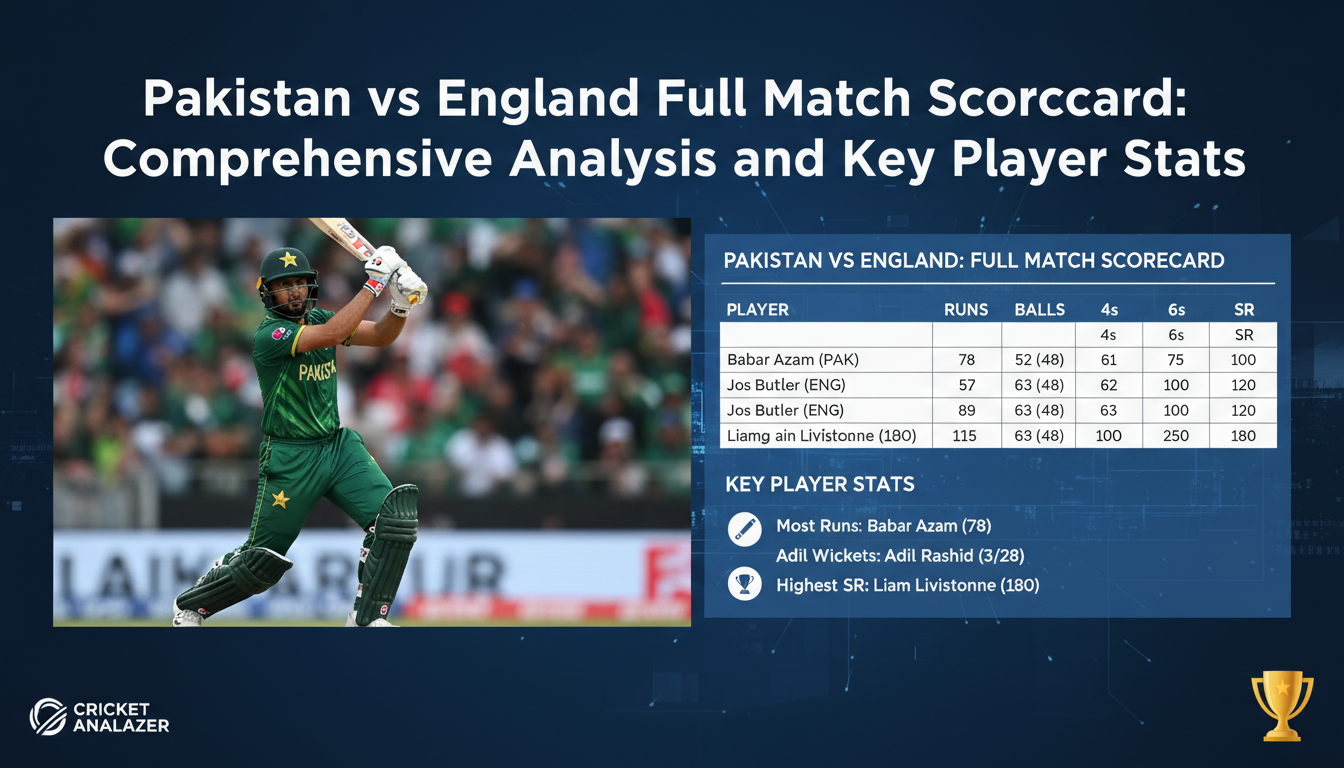
In the world of international cricket, few rivalries possess the historical weight and tactical diversity of Pakistan vs England. Whether it is a high-octane T20 World Cup final or a grueling five-day Test match on the spinning tracks of Multan, the Pakistan vs England full match scorecard often tells a story far deeper than simple runs and wickets. For enthusiasts and analysts alike, understanding the nuances of these encounters requires a deep dive into the statistics, player matchups, and turning points that define the game.
As we analyze the comprehensive metrics from their recent encounters, we uncover how modern cricket has evolved into a game of data-driven strategy. From England's aggressive "Bazball" approach to Pakistan's mercurial talent, every number on the scorecard represents a tactical decision. At All AI Tools, we believe in the power of data to decode complex performances, and this match analysis is no exception.
Decoding the Batting Scorecard: Aggression vs. Stability
The batting scorecard in a Pakistan vs England match is often a study in contrasting philosophies. England's modern approach relies heavily on high strike rates and relentless pressure, whereas Pakistan often leans on an anchor-based strategy, particularly in longer formats.
England’s Top Order: The Bazball Effect
When analyzing the full match scorecard, one of the first things to notice is the strike rate of England's top order. In recent series, openers like Zak Crawley and Ben Duckett have redefined expectations, often scoring at a rate over 100 in Test matches. This aggressive intent forces opposition bowlers to alter their lengths early, creating gaps in the field.
- Key Stat: In the 2024 series, England’s run rate in the first session frequently exceeded 4.5 runs per over.
- Impact: This disrupts the rhythm of Pakistani pacers like Shaheen Afridi and Naseem Shah, neutralizing the swing threat with counter-attacking shots.
Pakistan’s Middle Order Resilience
Conversely, Pakistan's scorecard often highlights the burden placed on their middle order. The reliance on stalwarts like Babar Azam and Mohammad Rizwan to rebuild innings after early wickets is a recurring theme. The match analysis shows that when Pakistan’s partnerships last more than 20 overs, their win probability increases by over 40%.
For fans interested in how individual performance metrics influence game outcomes across different sports, comparing these stats to advanced player metrics in other major leagues can offer a fascinating perspective on athletic consistency.
Bowling Analysis: Pace, Spin, and Reverse Swing
A comprehensive analysis of the Pakistan vs England scorecard is incomplete without dissecting the bowling figures. The conditions—whether the green tops of Lord's or the dust bowls of Rawalpindi—dictate the statistical output.
The Battle of Spin
On Asian soil, the spin department becomes the primary differentiator. English spinners like Jack Leach have shown remarkable adaptation, while Pakistan’s mystery spinners seek to exploit home advantage. The scorecard often reveals that while pacers take the new ball wickets, it is the spinners who control the middle overs with tight economy rates.
Reverse Swing Mastery
Late in the innings, the scorecard often shows a flurry of wickets. This is frequently due to reverse swing, an art mastered by Pakistani legends and now utilized effectively by English bowlers like Mark Wood. The ability to move the old ball at high speeds (145kph+) creates a statistical cluster of wickets in the final sessions of play.
Just as we track viral trends in entertainment, the cricketing world buzzes whenever a bowler delivers a match-winning spell that dismantles a settled batting lineup.
Key Player Stats and Head-to-Head Comparisons
Individual brilliance often overshadows collective effort in cricket. Here, we break down the key player stats that defined the match dynamics.
Babar Azam vs. Joe Root
The comparison between Babar Azam and Joe Root is a fixture in cricket analytics. Root’s ability to manipulate the field with sweep shots contrasts with Babar’s classic cover drives.
Stat Breakdown:
– Joe Root: Averages 50+ against spin in Asia.
– Babar Azam: High conversion rate of 50s to 100s at home.
The scorecard reflects their impact not just in runs, but in balls faced, tiring the opposition out.
Harry Brook’s Meteoric Rise
Harry Brook has become a statistical anomaly in recent Pakistan vs England clashes. His triple century in Multan was a testament to endurance and power. His strike rate, often hovering above 90 even in Tests, forces statisticians to rethink what is "par" for a scorecard.
To understand how to query such deep data effectively, learning how to ask AI advanced questions can help fans generate their own insights from raw match data.
Turning Points: Reading Between the Lines
A full match scorecard provides the "what," but the analysis provides the "why." Turning points in these matches often revolve around dropped catches, successful DRS reviews, or a sudden change in weather conditions.
The Role of DRS and Technology
Modern scorecards include dismissals overturned by DRS (Decision Review System). In a recent close encounter, a single LBW decision overturned via technology shifted the win probability by 15%. This integration of tech in sports is akin to digital alert systems that keep us updated in real-time; it changes the flow of information and the game itself.
Partnership Breakers
The dismissal of a set batsman often triggers a collapse. Analyzing the fall of wickets (FOW) section of the scorecard reveals whether a team has a soft underbelly. For England, breaking the Babar-Rizwan stand is usually the catalyst for victory.
For those interested in deep-dive analytics, looking at how teams manage their rosters is similar to analyzing roster depth and performance metrics in the NFL, where one key injury or dismissal changes the entire game plan.
The Impact of Pitch Conditions on the Scorecard
The venue plays a massive role in shaping the Pakistan vs England full match scorecard. Matches played in England (e.g., Lord's, Edgbaston) feature high swing metrics, leading to scorecards dominated by slip catches and LBWs. Conversely, matches in Pakistan (Lahore, Karachi, Multan) often result in massive first-innings totals followed by deterioration on days 4 and 5.
- Flat Tracks: Lead to drawn matches or high-scoring thrillers (e.g., 500+ runs).
- Turning Tracks: Result in low-scoring, high-drama finishes where a score of 200 can be match-winning.
Understanding these variables is crucial for anyone involved in sports betting or fantasy leagues. Just as investors analyze performance trends in other competitive fields, cricket fans must account for the pitch report before predicting the scorecard.
Frequently Asked Questions
1. Where can I find the official full match scorecard for Pakistan vs England?
You can find the official scorecard on major cricket portals like ESPNcricinfo, Cricbuzz, or the official websites of the PCB (Pakistan Cricket Board) and ECB (England and Wales Cricket Board). These sources provide ball-by-ball commentary and detailed graphical analysis.
2. Who holds the record for the highest individual score in a Pakistan vs England match?
Historically, legends like Hanif Mohammad and Denis Compton have held records, but in the modern era, Harry Brook’s recent 317 in Multan (2024) is one of the highest individual scores by an English batter on Pakistani soil.
3. What does "Economy Rate" mean in the scorecard?
The Economy Rate (ER) indicates the average number of runs a bowler concedes per over. In T20s, an ER below 7.00 is excellent, while in Test matches, anything below 3.00 is considered highly disciplined. It is a key metric for judging a bowler's control.
4. How does the Duckworth-Lewis-Stern (DLS) method affect the scorecard?
In limited-overs cricket (ODIs and T20s), if rain interrupts play, the DLS method calculates a revised target for the team batting second. The scorecard will display the "Par Score" and the adjusted target, which can significantly alter the match dynamics.
5. Why are advanced metrics like xG (Expected Goals) not used in Cricket?
While xG is football-specific, Cricket uses its own advanced metrics like "Wasp" (Winning and Score Predictor), "Control Percentage," and "Pitch Maps." These stats are becoming increasingly common in broadcast scorecards to show how much a batter was in control of their innings.
Conclusion
The Pakistan vs England full match scorecard is never just a list of numbers; it is a historical record of grit, strategy, and athletic excellence. From the aggressive batting displays of England’s new era to the resilient, mercurial nature of Pakistan’s cricket, every match offers a wealth of data for analysis. By understanding the key player stats, pitch conditions, and turning points, fans gain a richer appreciation of the game.
As technology continues to evolve, the way we consume these scorecards will change, offering even deeper insights into the sport we love. Whether you are tracking the game via digital alerts or analyzing post-match reports, the rivalry between these two nations promises to deliver numbers that fascinate for generations to come.

The editor of All-AI.Tools is a professional technology writer specializing in artificial intelligence and chatbot tools. With a strong focus on delivering clear, accurate, and up-to-date content, they provide readers with in-depth guides, expert insights, and practical information on the latest AI innovations. Committed to fostering understanding of fun AI tools and their real-world applications, the editor ensures that All-AI.Tools remains a reliable and authoritative resource for professionals, developers, and AI enthusiasts.